Monday, 27 December 2021

Screenwriting Professionally: 2021 edition

In what's become an annual tradition, I recount the highs and lows of my screenwriting efforts in the last year. A special year indeed: 2021 was my first year as an agented writer, thanks to the great Andy Townsend. It marked my first steps into broadcast drama and was the first time, in nearly a year, that I was able to start working outside again, as is my preference. The COVID pandemic had been, and still is, profoundly surreal, and trying to get back into 'the swing' after such a seismic shift in culture and society has been tricky.

Industries in 2021 - Economist Intelligence Unit

Has it been a better year than 2020? A firm YES - vaccinated, got talking to industry folk again and my productivity was up a good 100% compared to said prior. Was it a good year, for me? Did I achieve my own goals and did I grow as a writer? That is much more complicated to answer.

 
Jan-Mar (Winter): 

At first, the year started relatively quiet and slow - with my vaccine eligibility still months off, I was endeavouring to power through my action drama pilot, best as I could. I had been tinkering away on it since last autumn, believing it was a great new challenge, as well as showcasing my ability to write setpieces and something with a faster pace. Writing from home, given I live in a flat with others, was incredibly difficult: always distractions.

On the flip side, however, I progressed through the BBC New Voices scheme from last year. Now I got to do a Writer's room for series 2 of Jojo & Gran Gran (a Cbeebies megahit). Working with the producers and script editors of the series to conjure up stories and learn the particular flavour of the show was indeed a lot of fun. I even got to make the acquaintance of its lovely creator, Laura Henry-Allain.

Apr-Jun (Spring):   

Now this period ended very differently to how it started: work slogged on with the action pilot, but that lack of 'space' was possibly the worst it ever was. Work that should've been a few hours took days, if not weeks, to turn around. No matter how bad I wanted it, it was hard to muster up the energy. Add to that, a family health scare, and it was rough.

There appeared to be two bright spots amidst all this. Two things that could turn it around: first was my agent liked an old crime spec I had on the backburner, which needed some punch ups. The other was a new disability initiative on one of the continuing dramas, which itself was partially following through an earlier script submission I had made to the production team, which they had liked. If I could land these, the blockage would finally clear and I'd be back, right into the heart of the action. A new submission in a lucrative genre, and a shot on a beloved show.

And it all went wrong.
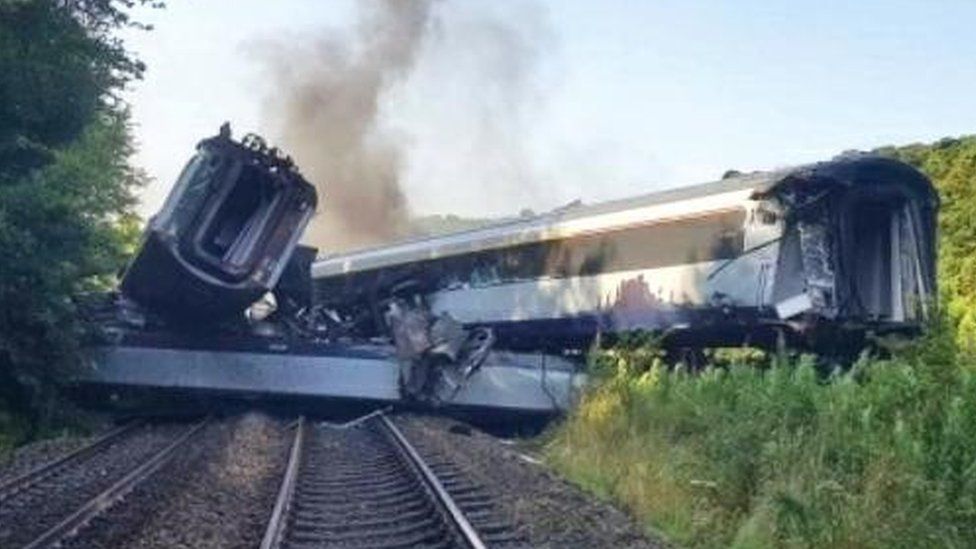
Three dead after passenger train derails near Stonehaven - BBC News

The timing of the scheme conflicted with rewrites, and due to a misguided sense of hope, mixed with a few drops of arrogance, I decided to put the crime pilot aside again. In the moment, it seemed like the right choice: the pilot was revealing deeper layers of problems, and the circumstances around the scheme, I thought, meant I was a shoe-in. I also, for reasons that make even less sense, decided to go full charge with the action pilot, thinking it was near finished (forgetting my own rules on having a varied slate). A few things happened regarding said scheme, which I cannot put up for public knowledge at this time, that meant it was not to be, and for reasons which I still have questions over.

At this point, I was feeling miserable. I had taken a gamble and it completely blew up in my face. Thankfully, it wasn't all gloom: I had kept in touch with a script editor-turned-producer from Doctors, who I sent over a script to. My own manners and diligence had, at least, granted me this much needed lifeline.

Jul-Sept (Summer): 

And here begins my Doctors journey. The script was liked, passed onto another script editor, Mary Flannigan, and ta-da, I was on the Writer's scheme. I've got posts planned to detail the process further, but over the coming months, I would pitch, draft and rewrite a trial script for the show under Mary's guidance. After what had happened with the 'other' show, this was such a boost and I loved the experience. 
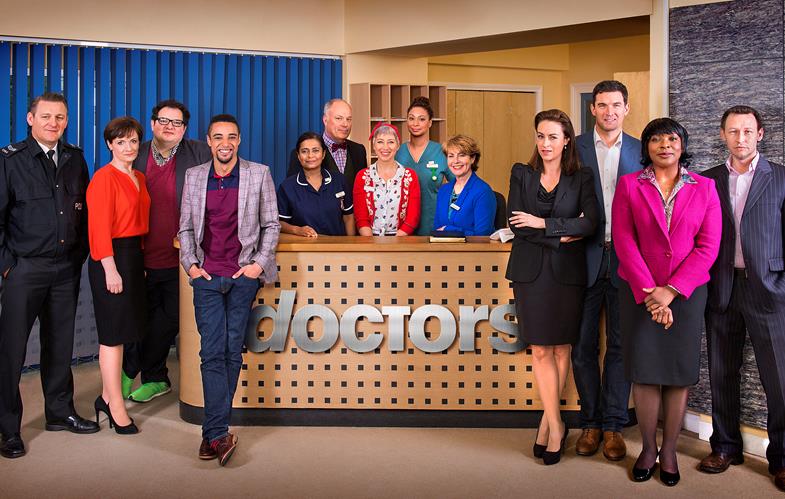
https://www.bbcstudios.com/media/2743/doctors.jpg

Plus, with my first shot in, I could start to think about getting outside again. I went, for the first time in my life, office hunting. It's a minefield, to put it lightly. Eventually, however, I found just the place and began to work from there.

As for the action pilot... I had begun to reversion it, trying to solve a problem around the protagonists that emerged in notes. What started out as something closer to Donnie Brasco was starting to drift into more of a mother-son story with this element of homegrown fascism. It wasn't a bad approach, and I thought it would add a lot of intensity and action to the project. However, what I should've realized, as the drafts and brainstorms worn on, was that I had screwed up. Not here, but back to the project's origins. I hadn't done my due diligence and was building on weak foundations, with a script that ended up more mimicking other shows than being its own thing.  

How had this happened: anxieties. I was worried about getting work and chasing shows I liked, that I wasn't paying attention to the right things. A writer must endeavor to maintain a clear and cool head in tough times, otherwise this can happen.

Oct-Dec (Winter again): 

The action pilot, not unlike a plane featured in it, finally crashed here. A last ditch effort to rescue the project by doing more a Shakespearean family tragedy, trying to add dimension to the lead, was a no-go. I felt awful: months of work and after all that, nothing to show for it. In two years, no new spec.

Doctors, thankfully, rode to the rescue again: I completed the scheme and secured the big prize: getting to write my first broadcast TV drama script. As of writing this, still on the treatment stage, but considering how fast the scheme went by, and what had happened earlier in the year, it was nothing short of a miracle. In addition, ITV called out yet again, with me landing on the 2021 Original Voices scheme, this time for Emmerdale. After a fun zoom workshop, I got to draft half an episode of a hypothetical episode.  In that same week, I attended the launch of Underlying Health Condition, and did some pitches for a major northern production company, so hey, the year ends on a bang!

Returning to the above question, did I accomplish everything I wanted? No. The saying 'one step forward and two steps back' is an apt summary of 2021: I am grateful for the success I did have. Breaking the continuing drama deadlock is a huge win, whatever else can be said. But where I failed, indisputably, was in craft: I did not grow as much as I had wanted to, and in turn, hurt my slate. I forgot basic principles and charged into situations with the wrong mindset. Never put your eggs on one basket, always spread yourself out and never take anything for granted.

 If I want 2022 to really hit the heights, changes will have to be implemented and certain tenets revisited. Discipline needs to be re-instilled: I fought hard to get here, and I'm not backing down.

Wednesday, 15 December 2021

Underlying Health Condition: A New Chapter for Disability in TV

If you've read this blog for any length of time, you'll know I'm not shy about talking about disabled issues in film and TV, as someone on the spectrum. Because of it, I've able to be part of some delightful things that have travelled the world (like the animated series Pablo). Representation is becoming a bigger talking point in this business, and I try to do my own little part to add an informed perspective to the conversation.

On Friday December 3rd, I was invited to the launch of Underlying Health Condition at none other than the Tate in London. What's UHC? a new report and initiative to improve what has been, frankly, the systemic failing of disabled talent in media in the UK for years. While headed up by award-winner Jack Thorne (His Dark Materials, Skins, Enola Holmes), this was an event, and a project, dominated with actual disabled voices. Among some of the speakers and guests included actress Ruth Madeley, Genevieve Barr and Tom Wentworth (both working on the BBC's A Word spinoff, Ralph and Katie). Watch the event for yourself at the following link:


Talent in various fields (screenwriting very much included) who, despite hard work and determination, have found themselves shut out of jobs and opportunities they were fully entitled to. Why? Because the industry couldn't be bothered to do the bare minimum. We have money for big star actors and elaborate VFX, but not for ramps or disabled-accessible toilets (know how many there are in UK film and TV? 1000? 100? Not, just one. In the entire country). 
 
They aren't asking for preferential treatment or some other tabloid nonsense about 'PC this, diversity quota that' - they are asking to be able to do their jobs. Because they are adults who want to work and create, not 'problems' or 'nuisances' to be brushed aside. They have the determination, the willpower and the work ethic to succeed, they only need space. If you recall my blog on it, Jack Thorne also discussed this at his powerful MacTaggart lecture - disabled people fighting hard and ending up with credit stolen or being unfairly dismissed from opportunities they were completely entitled to and had proven capable of doing.

Basic attention to detail and accommodation will do so much good - ramps, special kits, co-ordinators and proper toilets are the start. After that, actual sustained job support and training schemes that do lead to paid work and viable careers (for disabled writers, agents can also be a nigh-impossible hurdle to climb. I got lucky with mine, but how many others can say the same?). Merely more workshops or classes will not right a long-running ill, there has to be meaningful remuneration and strategy at play, an actual investment in the talent. Already, Channel 4 has adopted the proposed guidelines, and here's hoping more companies and broadcasters follow suit.

https://upload.wikimedia.org/wikipedia/commons/7/79/Starrrahmenrollstuhl.jpg
 Pictured: Not a valid reason to ignore someone

Will one initiative solve everything? No, but then UHC isn't a lone wolf - it works with and builds on other disability organizations, like DPTV (Disabled People in TV), 1-IN-4 Coalition, Triple C/DANC (Disabled Artists Networking Community, which if you're not, you should be a member. Lots of support and masterclasses available). Collective effort is how things will change in how disabled creators are perceived and hired.
 
If all of that sounds like soapboxing, then all I ask you people reading to keep an open mind and listen to what disabled artists and crew are saying in the video above. If nothing else, do watch the first ten minutes, which has a short film talking about what disabled people deal with on a regular basis in TV, including some faces you may know from your favourite shows. 

Friday, 26 November 2021

A Writing Formula... from the inspiration of Superman?!

Everyone knows Superman, the big blue boy scout from Krypton. Clark Kent, small town Kansas reporter is the last son of an advanced civilization who fights for justice against all manner of monsters and villains.

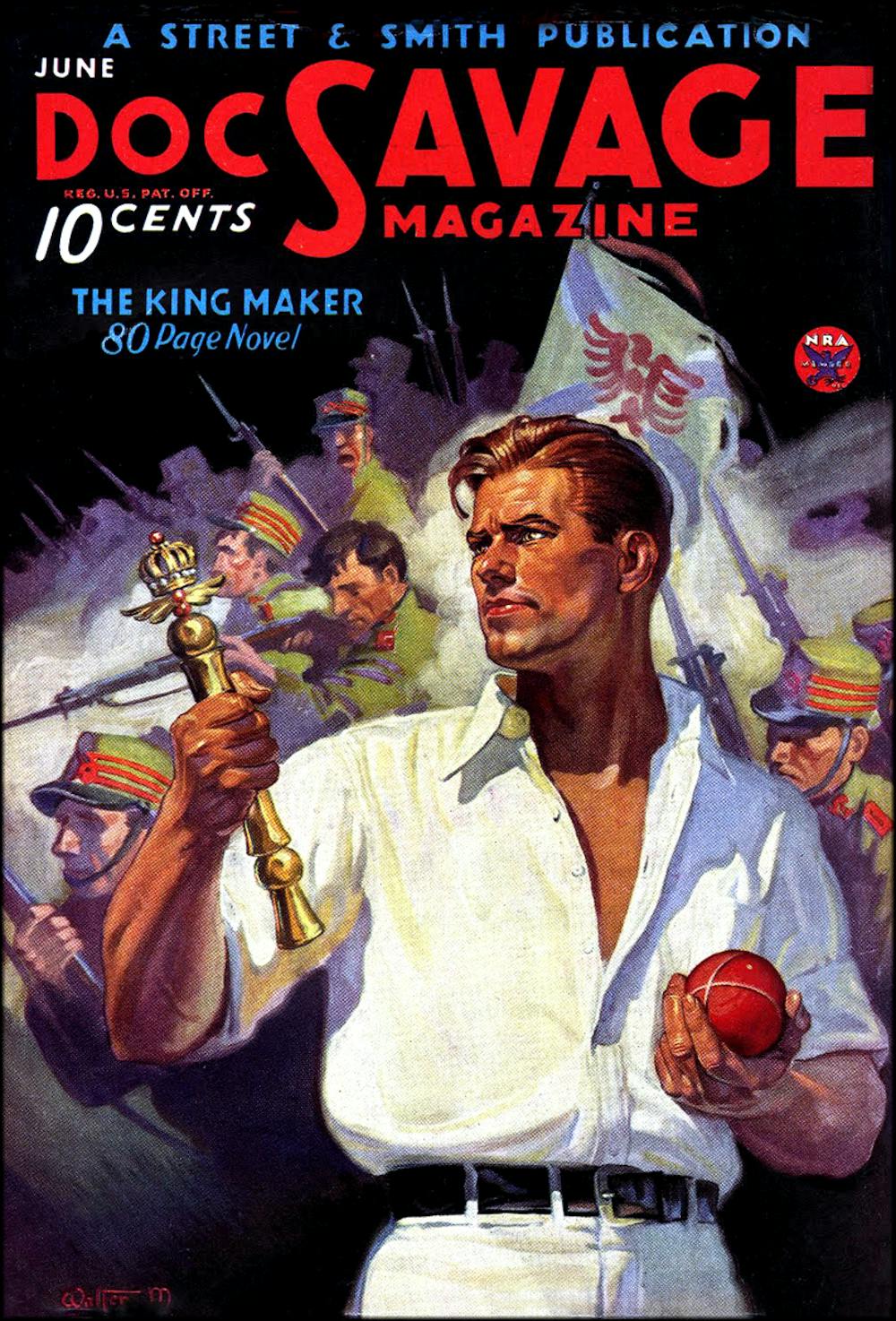
Some know Doc Savage, a super scientist who was an inspiration for the Man of Steel (even had his own 'Fortress of Solitude', an arctic base where he conducted experiments and meditated). A master adventurer accompanied by five war veterans, busting all manner of super crime. (Those of a certain age may recall the Bantam reprints with the James Bama covers. Or the cheesy movie with Ron Ely.)

Meet Doc Savage, the most famous superhero you've never heard of

Probably less known still, outside of pulp and 30s nerd circles, is Doc's original writer and creator, Lester Dent, a real life adventurer and treasure hunter, who wrote a lot of pulp material, not just Doc Savage. A body of work comprising of hundreds of stories, short and novels alike.

Like many pulp authors, Dent was a machine, a man who had to churn multiple compelling plots on deadlines for a monthly, or even bi-monthly, target and a readership numbering in the millions. For any writer today, that may seem pure insanity. However, Dent gifted us with his method for writing, which laid out an easy to follow formula. Credit to website Dirty 30s who archived this. Read it here: http://www.paper-dragon.com/1939/dent.html

 The Monsters (Doc Savage, #7) by Kenneth Robeson

In the event that it goes down (because this is the internet), here are the main bullet points: Dent has four criteria when he writes a pulp story. They are the following:

1. A DIFFERENT MURDER METHOD FOR VILLAIN TO USE
2. A DIFFERENT THING FOR VILLAIN TO BE SEEKING
3. A DIFFERENT LOCALE
4. A MENACE WHICH IS TO HANG LIKE A CLOUD OVER HERO

After that, he divide up a 6000 word story (typical for a pulp novel of the time) into four 1500 word parts (you can think of them as acts, and work exactly like they do). For Act 1/First 1500, he says: 

1--First line, or as near thereto as possible, introduce the hero and swat him with a fistful of trouble. Hint at a mystery, a menace or a problem to be solved--something the hero has to cope with.

2--The hero pitches in to cope with his fistful of trouble. (He tries to fathom the mystery, defeat the menace, or solve the problem.)

3--Introduce ALL the other characters as soon as possible. Bring them on in action.

4--Hero's endevours land him in an actual physical conflict near the end of the first 1500 words.

5--Near the end of first 1500 words, there is a complete surprise twist in the plot development.

 Act 2/Second 1500:

1--Shovel more grief onto the hero.

2--Hero, being heroic, struggles, and his struggles lead up to:

3--Another physical conflict.

4--A surprising plot twist to end the 1500 words.

Next, Act 3:

1--Shovel the grief onto the hero.

2--Hero makes some headway, and corners the villain or somebody in:

3--A physical conflict.

4--A surprising plot twist, in which the hero preferably gets it in the neck bad, to end the 1500 words.
 

And finally, Act 4:

  1--Shovel the difficulties more thickly upon the hero.

2--Get the hero almost buried in his troubles. (Figuratively, the villain has him prisoner and has him framed for a murder rap; the girl is presumably dead, everything is lost, and the DIFFERENT murder method is about to dispose of the suffering protagonist.)

3--The hero extricates himself using HIS OWN SKILL, training or brawn.

4--The mysteries remaining--one big one held over to this point will help grip interest--are cleared up in course of final conflict as hero takes 
the situation in hand.

5--Final twist, a big surprise, (This can be the villain turning out to be the unexpected person, having the "Treasure" be a dud, etc.)

6--The snapper, the punch line to end it.
 

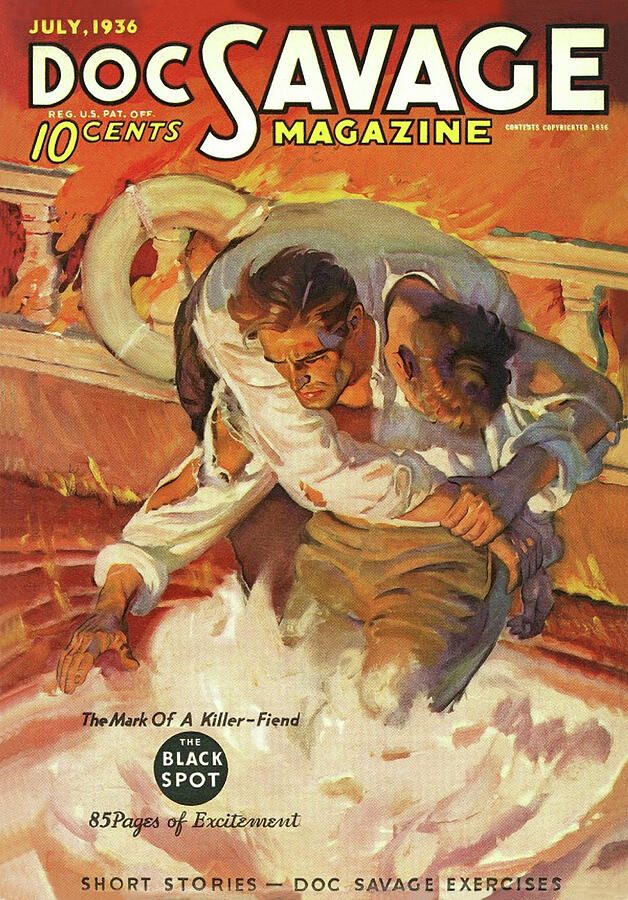
Doc Savage The Black Spot by Conde Nast

Detailed, right?

Not too dissimilar to modern paradigms we use for discussing structure and writing methodology. And it makes sense - given his line of work, you couldn't wait for the divine muse, you had to get a story down. It gives you a way to think about the pace of your story and what will keep your reader hooked. It may not be as fanciful as Blake Snyder's Pope in the Pool, but it is a reminder that act and writing theory existed long before Syd Field was around.

It's also a methodology not unlike writing for continuing drama or more procedural television today, where plot can take a level of primary focus over drastic character growth. This is a way to give a decently fleshed out cast new adventures every week, because character proactivity and choice still drives, and a format viewers will grow loyal to.

Tuesday, 19 October 2021

I'm working on BBC's Doctors

So, I finally have some work news and it's a whopper: I have just gotten a place on BBC One's Doctors, following completion of their writers scheme. Basically, it was a trial to write on the long running drama about a medical practice in Birmingham. The series follows the lives of several GPs and staff at the Mill Health Centre. There's love, there's laughs, there's loss and always a new patient with some new problem every day of the working week! 
 
As I succeeded to the script editor's satisfaction with said practice episode, now I get the real deal: pitching (and hopefully then scripting) my first broadcast drama credit.
 
 BBC Doctors (@BBCDoctors) / Twitter
 
It's been quite a trek to get here, having tried to get on the scheme two years ago, and not landing it. (On the flip side, it's a reminder to be gracious, as that script editor went onto become a producer and put me forward this time when I showed him a new, and better, script). I do intend to do a full post on the scheme and how the process to develop a Doctors episode works, but sufficed to say, do not let the quaintness fool you: this is a tough and demanding gig.
 
However, I'm really excited to get cracking on the real deal in the coming weeks, and big, big thanks to Mary Flanigan (no J, as she made very clear!) and Simon Curtis, for giving me this opportunity, as well as Michelle Goode of Writersofluid, whose notes helped polish the drama script that got me onto the trial in the first place. And in true awards tradition, not forgetting my friends and family, who've cheered me on through not just this, but last year and a bit as I've navigated a turbulent industry and media landscape.

Saturday, 11 September 2021

HOW DO I GET AN AGENT? - Screenwriter's Survival Kit

The big question that every writer has. The age-old dream that the agent is a wondrous wizard who, upon choosing you, will grant your deepest wishes and get you all the jobs and all the monies. You go from a  nobody to champagne at the BAFTAs and royally rolling in residuals dough. Oh Saints be praised!

Curtis Brown Books (@CBGBooks) | Twitter

Well, I can tell you right now, that's a crock.

I love my agent to be clear, he's a cool guy, but he's not a miracle worker. No agent is, and I think writers think about agents in a way which is harmful to both their development, as well as to the potential relationship they could have when they find one. Agents cannot guarantee you consistent work, and they cannot guarantee you will always make money between big gigs. Companies, broadcasters and even studios can only buy so much material, and the UK doesn't exactly have the same resources as Hollywood.

What they are is middle men, the guys who get you past the gatekeepers and put you in rooms with people who may have the money and work. They're a stamp of legitimacy that says 'this writer is not a crazy person who will stalk you for not reading their script'. They take care of contracts and other paperwork, enabling you to focus on writing the best material you can and not fret so much about networking.

Can you get work without one? Yes, I did a whole article about that. However, if you are getting to a point where you need one, I'll offer up two things for you: the standard wisdom on how to get one, and then how I did it.

HOW TO GET AN AGENT (CLASSIC STYLE):

  • RESEARCH: Look up the writers you admire and want to be like. Look who represents them and where they are. Some of the classic names include Curtis Brown, The Agency, Valerie Hoskins, Knight Hall Agency and Independent Talent, but that's just the surface. A great tool here is The Writers and Artists Yearbook, full of names of places looking for submissions.
  • REFINE: Get that script, if not several (actually, make it several) as good as you can. I would really advise you take your time and have two, or three, in sharp shape. One is not enough - you need to show range and that you're not a one trick pony.
  • REFERRAL: Exactly what it sounds like - get someone in the business to read your script and, if they like it, ask them to act as a referral, an industry recommendation. I touch on a way to do this in another piece.
  • QUERYING: The most daunting part - actually asking for a read. Usually, agency have a submissions guideline on the website, which you MUST follow. DO NOT, I repeat, DO NOT DUMP SCRIPTS ON PEOPLE. If you blind-send, or worse, spam send to everybody at once, you will crash before you've even started. It makes you look like a cynical huckster out for a fast buck, instead of someone building a professional relationship. As for the query itself, much like the networking article I wrote, there are some standards: a succinct introduction to your self; why you'd like this agent to rep you, and a quick pitch of the script you'd like to send. Be tight and to the point.

HOW I GOT AN AGENT

I did the above and got good responses from several places, but no firm yeses. Big or small, the size of the agency made little difference (but don't lose faith if you're waiting. It's a slow game.) However, I did, through my networking, send a script off to a development person at Dancing Ledge, who passed it onto Andrew Roach, an agent specializing in disabled talent, who passed it onto my current agent, Andy Townsend at the Galton Agency (who work with Roach's clients on screen projects). This was the power of a referral in action, and then some.

Galton Agency

Andy read my stuff, liked it and we had a meeting. We got on well and he asked to read some more stuff, so I sent it over. In total, he read four scripts, counting the one from Dancing Ledge. Satisfied, he offered me the contract and I signed. Since then, we've done catch up meetings once a month, discussing projects and places to submit to. It's been a pretty easy-going thing, all told, and he has never pressured me to do something I wasn't happy with.

I hope this has been of use - the big thing is not to stress. Like writing itself, it's a long process and there will be mistakes and failures. So long as you understand this, you'll manage fine.

Friday, 27 August 2021

Jack Thorne's MacTaggart lecture: why 'Best Person for the Job' isn't an answer

Jack Thorne is a UK film and TV powerhouse (too much to list here) and staunch ally of disabled creatives. At this year's Edinburgh TV Festival, a major industry event, he handled the much-coveted MacTaggart to deliver a damning indictment of how the industry has time and again failed disabled people. As an audience, as creators behind the camera and as performers in front of it. Go watch it and come back here after.


So, pretty tough listening isn't it? And sadly, all too true. Speaking as an autistic screenwriter, though I can't claim to speak for all disabled creators (running all the way from the physical to the mental, with each have its own traits and challenges), it's mind numbing how little progress has been made, and how the success stories have made no difference to how shows are made, or how talent is reared and supported. I even commend Thorne for admitting his own blindspots (though obviously he didn't have the final say on casting in Wonder, as one of several writers on a Fox movie, to be fair) and glad to see his partnering up with more disabled creators like Genevieve Barr and Ruth Madeley. 

While reception has been overwhelmingly positive, because this is about representation, there were the usual crabs-in-a-bucket with the same tired, boring, intellectually empty points: 'Acting is about pretending to be someone you're not', 'representation doesn't matter', 'best person for the job, background is irrelevant', 'meritocracy' and of course, splitting hairs about 'um ackshually, 20% of the UK population is not disabled because blah blah blah' from people who suddenly became expert data scientists. And next-to-none of whom are in the industry.

I've talked about representation in the past on here, as well as my experience on Cbeebies' Pablo, but this time I wanted to really zero in on why this attitude is a problem, the culture it creates, and where the audience has a role to play as well.

To begin, I get it: It's unrealistic to expect your average audience member to have the same in-depth knowledge of how film and TV works as an insider. From a certain POV, they shouldn't need to - fans are there to consume and talk about the content when its done, not engaging with broader production questions. The problem is the internet, and in particular social media, has broken down a lot of the walls. Now, talking to creators and companies has never been easier - the problem then becomes audiences are not used to a lot of industry chatter and so, wind up in discussions they, technically, have no business being involved. Big problems in the industry, whether it's the UK or US, Disney or BBC, relating to issues around outdated structures that artificially impede the career progression of people from a number of minority groups, seem like sudden changes to newcomers (even with multiple surveys and reports, like the ones Thorne cites in the lecture, showing how long this has been going on).

Because audiences don't have, or sadly in some cases, don't care, about all that background and don't understand when a creator is talking about issues with, say, more disabled characters in TV, it's easy to mistake a plea to fix a longstanding problem with some kind of sinister demand or entitlement. When you don't understand how hard it is for, say, a disabled writer to get the same shot, or at least the same amount of opporunity, as their able-bodied peer, it's easy to just say 'best person for the job' or 'I don't see disability, just the person'. How many times do you think these creators have been told that and not only not seen that sentiment lead to change, but now have it be used to tell them to, basically, 'shut up and be grateful' by people who don't even work in the arts at all?

And speaking of that, it's also tiring as a creator to see our achievements get blown aside in an instant when one of these types tries to tell our stories and royally bungles it. You may have heard of Sia's directorial debut, Music. The title refers to an Autistic girl, played by Maddie Ziegler, who is placed in the care of her drug dealer sister. With a premise like that, you can guess where it goes, but what's important is that A) Neither Sia nor Ziegler are autistic, B ) Autistic actors are not in the film, even in background roles, C) No Autistic expert or group was consulted during development, save for some brief interactions with the notoriously controversial Autism Speaks, widely condemned for treating Autism as a disease. As counter examples, Atypical and Pablo (Hey, that's a-me) all involved autistics in creative roles: yet, when Music became a hot topic, with discourse raging about its portrayal of the condition, were any of these shows mentioned? Did anyone cite that a show like Pablo, effectively, disproved both Sia's choice and, indeed, the very methodology of Music's development, treating actual autistic voices as tertiary? Nope. 105 episodes, airing on major channels, a worldwide fanbase and a much publicized selling point (a pretty good sign of a job well done. The BEST kind, if you will)... and it might as well have not existed.

However unintended, the message is clear: autistic creators are not to be given chances on larger projects, precisely the kind that can change the narrative, because a highly successful musician said so, and all the previous autistic movies and shows don't amount to a 'valid' counterargument. See how that applies to what Thorne is talking about here? How the disabled shows he was able to make were done on breadcrumbs, and even when they got acclaim, and he went on to work on big properties, still nothing changed. How broken is that metric where success doesn't equal 'make more'? The one thing that the film and TV industry can be reliably called on to do, and this is the exception? Because of that, I wrestle with creating autism-based scripts and often wonder if my mentioning it limits my job prospects. Why should it be like that though? Why should a script, that's been worked hard on, proofed, run by other peers and thought good quality, be arbitrarily denied a chance for something unrelated to merit?

As an additional point, I do also think there is a blind spot in Thorne's lecture: staffing. He alludes to Silent Witness and Liz Carr's battles, but I feel this needed more hammering home from a writer/director angle. It's not enough just to greenlight disabled stories, as vital as that is: it's about getting disabled creators the experience and credits needed to not just get those shows in front of commissioners, but also to pay their bills and put food on the table. Disabled artists don't just want to talk about themselves: they're fans of shows like you are. They have dream jobs too, whether that's Eastenders, Casualty, Hollyoaks, Doctor Who or Call the Midwife. We need to ensure they have the same shot as anyone else on getting on this shows, and not just for 'the disabled story' but because they are professionals who can tell good stories period. As long as just blindly parroting 'best person for the job' is seen as the default response, this will not happen because it others disabled people as somehow 'not the best'.

This is as personal as I've ever gotten on this blog, but I need to say it: I am tired of having to fight for my basic dignity, and I've seen plenty of other disabled people share the same: tired of justifying ourselves, tired of asking to be treated like the thinking, feeling adults we are. Tired of being written off or insulted by quacks, anti-vaxxers and religious hypocrites who claim we are a 'mistake', a 'problem' that needs to be fixed or cured. Tired of constantly having to deal with nonsense about 'diversity hires' and 'affirmative action' being the reasons why we achieve anything, instead of y'know, hard work and our pure determination. We are people. We are human.

And at the end of this, what I think we have is a tale of two faults: the industry and the audience. A wealth of great talent is there, ripe for picking, and through them, exciting, funny or stirring stories. If we want to move the needle, then every level needs to address how we treat creatives from backgrounds outside the standard. Commissioners who will fight for change, and audiences who will be willing to take a chance and have empathy, or if they like what has been made, demand more. Otherwise, the cycle continues and benefits no one. Not talent, not the audience and not culture, and if we got the Snyder Cut and redesigned Movie Sonic through pressure, why can't we get this?

Saturday, 17 July 2021

''Does Fanfiction count as a writing sample?'' Going from Fan to Professional

The long and short answer, most of the time, is no. Professional producers in any sector of media (film, TV, comics, radio, audio, novels, games etc.) want to see your vision, your voice, what you bring to a project. They want you. Fanfiction won't do you a lot of favours and is almost never advised as a proper writing sample: it's legally in a grey area, you're working with characters you don't have a legal license to use and it doesn't do enough to sell you as a writer in your own right. Plus, most of your favourite properties already have the agented writers banging on their doors: you will simply raise the odds against yourself.

There is ONE major exception, which I will come onto in a few paragraphs.

Is that to say fanfics are worthless? Not necessarily: Anywhere you can train up and build up experience is always handy when it comes to writing. Refining your craft is what counts, not where you do it. You don't have to worry about budget concerns or exec notes, so only your imagination is your limit. However, a balance with original work is vital if you actually want to make the jump from amateur to pro.

I do not believe the practice of working with other properties, unlicensed, is useless either in craft: not just because of the upcoming 'exception', but because adaptation is one f the bread-and-butter gigs, whatever field you get into. Working with others' materials is something you will come across, and getting some practice in without producers breathing down your neck, capturing another style and voice, can be handy.

Here's a five point plan I've cooked up if that's your game:

1) What is your goal? Do you want to be a working writer, or just writing one property? While that may sound arbitrary, it's important to consider because they each need different things: if all you want is just to write Who stories and nothing else, you're better off sticking to fanfiction sites as the grind exceeds what you really need. It may not be canon, but if you enjoy writing in that universe, that shouldn't matter. 

If, however, x or y franchise is just 'a goal' and you want to have a full career, beyond that, then that's a whole other kaboodle. Do you have favourite genres? What style do you like to write? What subjects or themes interest you? Do you have weird or funny memories, friends or relatives that could provide a great basis for a story? Write those and give yourself plenty of time: no one will ever thank you for giving them rushed work.

2) Being realistic. Getting to any dream is slow, and this doubly true for writing. The addage is 'it takes 10 years to break in', which is a good metric (though many have done so in half the time) to avoid disappointment and losing your passion. Treat nothing like a guarantee and be ready for a lot of unreplied emails and non-answers as you build a body of work. It's just the reality of the entertainment business.

3) Learn learn and learn: invest in your education. Read scripts and prose, learn drama theory, take classes/workshops and join writing groups. Sharpen those skills and be open-minded. Always refine your work and approach, which thanks to the internet, has never been easier to do. Youtube is awash with free writing tutorials, lecture and seminars, if you're really tight on cash. It's also great as it's flexible to suit your current lifestyle. Learn what pitches, loglines, treatments and beat sheets are - they are a necessity in professional media production.


4) Build the CV. Much fun as fanfiction is, it won't count for much for a track record of professional work that proves you can work on that level. Good news is there are plenty of opps out there: online theatres and podcasts that will perform short audio plays, sketches and monologues, which is good for building up work. Same with physical theatres - scratch nights are always great for putting on short bits of new (original) writing. BBC Writersroom, London Playwrights Blog, Writers Services, theatre websites are full of opps. Do you have prose? Submit short stories to magazines, websites and collections - they will usually provide submission details on there too. Pay can be dicey so make sure they are transparent about that.

5) Network - meet people in the business. Producers, script editors, development assistants. Even if you don't/can't go to in person events like festivals, you can find personal websites and emails pretty easily online. Here, I did a whole article about how to network and make contacts. You're welcome.

And now, for the exception: in the American TV system, you can submit fanfics. Kind of. They're called spec scripts, meaning you write a hypothetical script for an existing show, though you will never submit to that specific show, but to ones like it. If you wrote an Law & Order, it'd get sent to The Rookie or Bosch, for example. I did an entire piece on that here, so go check that out as there's a lot to chew on.
 
 
But above all else, just remember to have fun. Don't drive yourself crazy trying to reach an arbitrary goal - learn and enjoy the process, because that love will show on the page.